01
Kittl Agentic AI
Current hands-on production experience: owned the Agentic AI project at Kittl, from architecture and technical direction through to production delivery.
AI ENGINEERING REVIEW & VERIFICATION SPRINT
We redesign one production workflow so less senior attention is spent reconstructing context, checking repeatable issues and fixing avoidable rework.
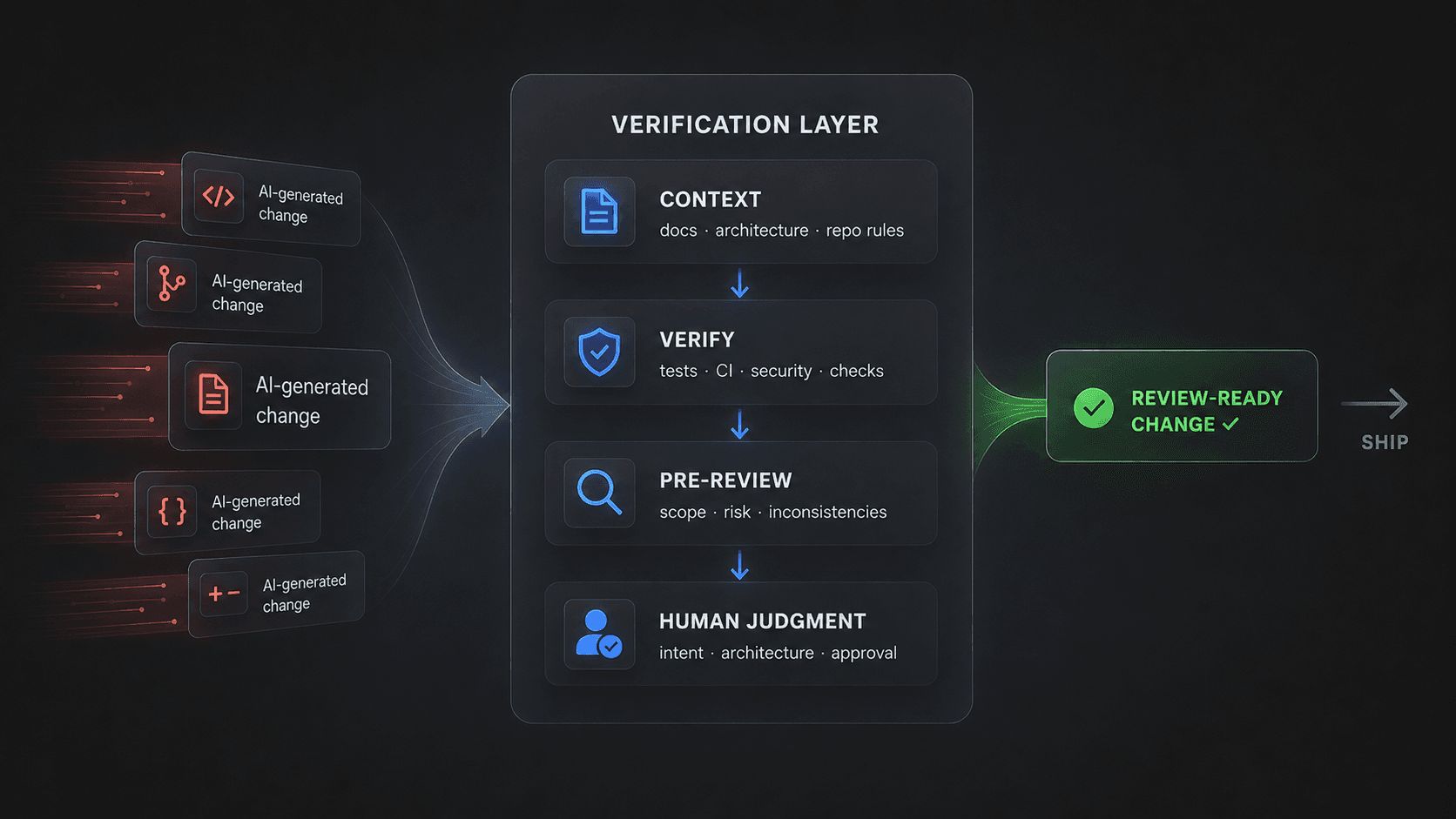
We build the verification layer between AI-generated changes and production.
Context, deterministic checks, AI-assisted pre-review and clear human sign-off — designed around your existing workflow.
PRODUCTION AI ENGINEERING
01
Current hands-on production experience: owned the Agentic AI project at Kittl, from architecture and technical direction through to production delivery.
02
Designed an AI-assisted engineering sign-off workflow adopted across approximately five product teams and used on 23 projects.
03
Direct delivery also includes an AI/ML engineer with experience across machine learning, NLP/RAG, computer vision and production-oriented AI systems, backed by an MSc in Computer Science.
WHERE THE SAVED TIME DISAPPEARS
01
AI can increase change volume while the same engineers remain responsible for understanding intent, architecture and risk.
02
A change can look correct while the reviewer still has to reconstruct repository rules, assumptions, edge cases and why the implementation exists.
03
Weak context, oversized changes and verification gaps move the cost downstream into review rounds, debugging and cleanup.
If none of these is materially costing your team time today, this is probably not the right pilot.
THE SPRINT
We take one production workflow where AI-assisted changes already create review or rework cost and improve the path before senior sign-off.
The intervention depends on the actual bottleneck. We do not install a generic “AI review stack”.
We do not replace engineering judgment with another AI layer. We make the expensive human judgment easier to apply.
When agents repeatedly miss architecture, rules or previous decisions.
When generated diffs are too expensive to understand.
Through the relevant tests, type checks, linting, static analysis, reproduction steps or CI gates.
For cheap, repeatable issues before senior review.
So accountability remains clear.
Using one to three practical workflow measurements.
We choose one workflow, map where review/rework cost is created and agree on a practical baseline.
We change the context, workflow boundaries, verification gates, pre-review or sign-off path required for that bottleneck — not your entire engineering system.
We compare the agreed evidence, document the workflow and leave maintainable source-controlled artifacts with clear team ownership.
You work directly with both engineers from diagnosis through implementation and handoff.

AI & Software Engineering Lead
Senior software engineer focused on production AI systems, agentic architecture and engineering workflows. She currently works at Kittl, where she owned the Agentic AI project from architecture and technical direction through to production delivery. She has also designed AI-assisted review, testing and quality workflows used across multiple product teams.

AI/ML Engineer
AI/ML engineer with experience across machine learning, quantitative modelling, NLP/RAG, computer vision and production-oriented AI systems. MSc in Computer Science with a machine-learning focus, with applied AI engineering experience dating back to at least 2020.
No sales-to-junior handoff. The people shown here are the people working on the pilot.
FOUNDING PILOT
€4,500 fixed
plus VAT where applicable
One production workflow · 10-business-day delivery window · direct access to both engineers · implementation + handoff + before/after result memo.
Send us the workflow that currently creates the most review, rework or context reconstruction. If it fits a bounded pilot, we will define the scope and baseline before work starts.
You can. This pilot is for teams that would rather use a bounded external intervention to diagnose the bottleneck, implement the first workflow and leave it maintainable than spend senior internal time discovering the pattern from scratch. There is no long-term dependency requirement.
No. Human accountability remains explicit. The goal is to move cheap, repeatable verification earlier so senior reviewers can spend attention on intent, architecture and risk.
The minimum required for the agreed workflow. Production or sensitive customer data is not required by default, and access should follow your existing security and data-handling policies.
There is no guaranteed productivity percentage. A bounded negative result is still useful evidence: you know what not to scale, and you keep the implementation, documentation and result memo.
The pilot ends with a handoff. If the evidence supports another workflow or broader rollout, that is scoped separately. There is no automatic consulting commitment.
Contact
A few sentences are enough. Tell us your team size, the AI coding tools you use and where review, rework or context reconstruction is consuming time.